


Writers from a Writer Ep. 1: Emily Dickinson
- Maya Dietrich
- Jan 19
- 9 min read

Hello and welcome back to the dreary hellscape that is my mind. I'm kidding… mostly. I was looking back at this last year over the break, and I realized that I've barely written on here, oops. Ideally I'd like to post weekly, but I know that that's just not possible considering all the things on my plate at the moment (work, academics - a full course load at that - and some very exciting things that I've been sitting on for months now and I really need to get my act together and deal with). So you can see how my blog has easily become sidelined (mostly because I have eight wondrous readers of whom I have no idea their identities, so cheers to you eight people!).
I now turn directly to this new idea I had at the start of this year - I think it was actually December 31st to be specific - a new series I'm terming: Writers from a Writer; the idea is that I, the writer in question, will study twelve authors I find interesting from across genres and mediums and learn a little bit about their lives and their writing processes along the way, concising it here for you. On top of that, I will also venture forth into the actual world of physical writing, taking a sample of one of their works, studying its basic form and style, and attempting to create my own piece of writing inspired by theirs. I italicize this to note its distinction from copying and replicating, two things of which I will most definitely NOT be doing. The point is to
gain a hobby (we all need more of those),
develop the ability to study the people and things that interest me outside of my usual classes, &
hone and better develop my own skills as a writer, hence the decision to take valuable skills these successful writers already understand, so that I can become a stronger (and hopefully someday) official writer who can deftly switch between genres and styles, while keeping my own voice and tone throughout!
To properly do this (and to ensure I post more on here…) I will attempt to do this monthly. So by the end of the year I will ideally have done twelve authors over the next twelve months. Huzzah!
That being cleared up and explained, onto my next order of business: January's Writer from a Writer!
Emily Dickinson was born December 10th, 1830, and died May 15th, 1886 in the same place she was born: Amherst, Massachusetts. If I'm being honest with you, I feel a very deep connection to Emily Dickinson. She lived most of her literary life with the understanding that she would remain almost entirely unknown, her poems being too unique, honest, and completely new to the world of poetry than her time was prepared for. She has often been mistaken for a 'recluse,' a sentiment I would like to readjust in this post… but more on that later. Emily Dickinson typically wrote at the desk in her bedroom, which looked out onto the street. It looked a little something like this:

I too have a desk, but to be frank I use it strictly for school-related stuff, and don't usually find that much inspiration strikes there. Also, it does not face a window, which I think explains a lot about her writing when you remember that she faced nature. I do, however, frequently get ideas while in bed, usually when I'm attempting to sleep… I know every sleep enthusiast out there will tell me "Never do anything but sleep while in bed!!!" but honestly? I really don't care. If I get an idea, I'm writing it down. End of story. Also, my bed does face a window, which satisfies this requirement, which I was fairly set on attaining.
It also seems to me that she didn't go chasing ideas. Maybe she did and I'm wrong, but her poetry reads with an air of completeness that I find comes through writing only when an idea strikes, not when you force inspiration to arrive, (ideas love to actively ruin your day by popping into your head at the most inconvenient times possible, I find). This is something I already do. I don't typically sit around hoping to get an idea when it's convenient for me, rather, I go through the day open to hearing that fickle voice of inspiration, and listening to it when I do (which often means that, like Emily Dickinson, my thoughts also mostly get written down on scraps of paper).
She mainly wrote about what was on her mind: death, passion, love, friendship, fame and success, among many other things. She noticed the beauty of the natural world around her, and often borrowed it to create very vivid poems that get lodged in your brain. She also uniquely uses something along the lines of an em dash - a little dashed line between her thoughts. I don't know the meaning with which she intended for these, but they usually make her poems read a bit more musical and interspersed than if she hadn't. I use em dashes a bit differently when I write, but I think the act of using them at all is close enough.
She also began collecting her poems into short works, almost like a little handmade book, which are now called "fascicles," which she sewed together. I happen to do something rather similar! I was lucky enough to be exposed to the world of "chapbooks" (of which I highly recommend any writer to make), while in high school. These are a short - often handmade as well - collection of poems and/or short stories, bound into what I'm coining small little 'idea-hubs.'
Now that we've reflected a bit on her writing style and life, I'd like to quickly go back to that idea of her being a 'recluse'...
In short, she didn't live her entire life as a mysterious nobody. She had friends, people!! Lots and lots of friends!! She wrote extensive letters to many correspondents, including known editors capable of publishing her work (of which they did a few), and had many close friends from her schooling days at Amherst Academy, who she was known to encourage furthering their education through consistent and diverse reading, individual study, and conversation. This rash association of her with being a 'hermit' is, I wholeheartedly believe, a completely incorrect idea of her life.
It is true that she never married, and it is true that she increasingly devoted herself to her writing, oftentimes prioritizing her creative life over a social one, and it is true that nearing the end of her life she mostly stayed in her home, never having moved out of her parents' grand estate (because she did not marry).
BUT, we have to look at these aspects especially of her life in conjunction with the time she comes from, and the point at which it is said she began to pull away from a more sociable life.
Firstly, she seems to have been a very friendly, approachable person while in school from 1840-47, where she and her fellow female students were unusually encouraged to devote genuine time to their studies. They were expected to meet the same standards as the men their age who were also in school, and were oftentimes given their professors' old assignments from their university days for further reading and study. Her education was something Emily Dickinson highly valued, and it was a fundamental time in her development as a writer and person. However, this encouragement for middle-class women to study was, of course, unusual for the time, and eventually she was expected to put less energy into her schooling for the sake of her growing home duties. This change was marked by her enrollment in Mount Holyoke Female Seminary from 1847-48. A female seminary, I have learned, was also quite common for women of her class and age, and followed the same basic idea as was popular in Christian schools of the time. That being that there were those who were "established Christians," those who "expressed hope," and those who were "without hope." It has long since become a bit of an urban legend that, when asked if all who wanted to be Christians to rise, Dickinson remained the only student seated. I have no idea if this is true or not, and lest I invent both a time machine and an invisibility cloak, I, like the rest of the world, will never know for sure. But since she only remained there for a year, it is possible that she was essentially deemed a lost cause and sent back home. Another possibility that's important to note in her leaving of Holyoke was that the school simply didn't have much to offer her, since she had had such a rare and relatively diverse education for a woman previously at Amherst Academy.
Keeping this in mind, when we now think about her 'hermit-ness,' it's clear that around the time she began pulling away from certain social gatherings (1848), it wasn't because she was some kind of social recluse, but rather, understood what was expected of her as a woman, disagreed with many of the beliefs her school friends were more eager to embrace (for survival or genuine agreement I will never know), and therefore sought more time with her authors and poems than with people directly. BUT, she still wrote to them all, she didn't just vanish off the face of the earth! On top of this, by 1851, Amherst was in the midst of a religious revival, so essentially everyone was claiming to hear the voice of God and feel a personal conviction to join the Church left and right. This was true for the Dickinson family as well, including Emily's close friend and sister-in-law Susan (Sue) Gilbert. In a letter to her friend Jane Humphrey, Dickinson reflected how she was "standing alone in rebellion, [refraining from intense religion]" These differences in priorities likely did strain her friendships, which has been theorized to be evident in a shift in tone in her letters to Sue, but she still kept in touch with her friends and family. Again, she didn't vanish off the face of the earth!
In general, as her social life declined and her writing became a much bigger focus, her poems took on distinct themes and styles that she continuously went back to throughout her intense writing years (widely considered to be between 1855-65). She wrote about death and life and beauty and pain - but she did it in a completely new way, often purposefully not rhyming lines, which have been edited on occasion so as to make them 'more suitable' for general audiences, but would change the tone and style that is distinct to her writing. For example, her poem "There came a Day at Summer's full" the fourth stanza reads:

She does the same thing in the sixth stanza, too:
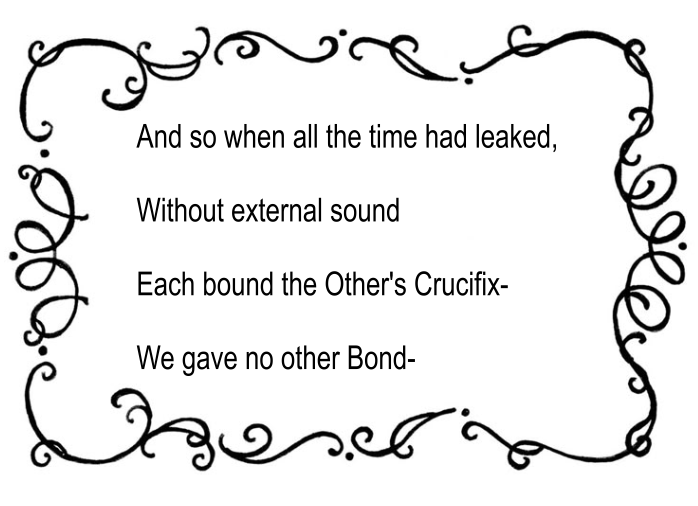
I find the unique structure to her writing much clearer in this one, which purposely stops the rhyme short by the last line. This gives it that unrhythmic feel that shows great skill and control over words in the English language and also a personal style that makes the writing stand out. But I suppose that was seen as strange and pedantic in her time - their loss!
Now that we've covered her life and a bit of her writing style, I think we might as well just jump straight into my chosen poem of hers, and the ways in which I've taken inspiration from her life and work.
The following is one of my favourite poems of hers, it's short too (I've yet to come across one that isn't, which I appreciate of our deceased friend and teacher), which I have broken down and analyzed to the right.
If I should cease to bring a Rose:

If I should cease to bring a Rose
Upon a festal day,
'Twill be because beyond the Rose
I have been called away -
If I should cease to take the names
My buds commemorate -
'Twill be because Death's finger
Claps my murmuring lip!
Feel free to read my scribbles, but if you chose to ignore them, that's alright too. They're convoluted and messy but help me get a better grasp of the poem, so they may or may not do the same for you. The choice is entirely yours.
Ok, now onto my poem. Here she is!


If you'd like to read Dickinson's much more cleverly structured and stylized poem next to my completed one (notice how I didn't say against), feel free to do so below. Her's is on the left, mine is on the right.


I'm nowhere near the level of talent Emily Dickinson is and was (she was also about nine years older than me when she wrote "If I should cease to bring a Rose" in 1858), but still, I made a valiant attempt I feel.
That's it for January's writer of the month! I hope you enjoyed it (if you did read all the way to the end), and found it insightful and entertaining (two things I hope my writing on here always does, but maybe that's just a silly little daydream).
For more information on Emily Dickinson, please refer to the links below (+ so many more duh there's so many sources on her). This is not an official research paper (obviously), so don't take it as such! All the facts I say in here are public knowledge and are available to learn in-depth at the links below.
*I am also in the process of reading The Complete Poems of Emily Dickinson edited by Thomas H. Johnson (the first person to publish a complete collection of her works by the way!), which happens to have a very insightful foreword into her life and writing, which I would also recommend.
☾⭐︎⭐︎☾⭐︎⭐︎☾⭐︎⭐︎☾⭐︎⭐︎☾⭐︎⭐︎☾⭐︎⭐︎☾⭐︎⭐︎☾⭐︎⭐︎☾⭐︎⭐︎☾⭐︎⭐︎☾⭐︎⭐︎☾⭐︎⭐︎☾⭐︎⭐︎☾⭐︎⭐︎☾⭐︎⭐︎☾⭐︎⭐︎☾⭐︎⭐︎☾⭐︎⭐︎☾


Comments